Track Reading Habit for Free: Paper vs Apps (2026 Guide)

If you want to track reading habit consistently without paying for an app, start with a method you will actually use. Most people do not stop reading because they dislike books. They stop because reading never quite becomes a habit. A book sits on the bedside table for weeks, and the intention to read more slowly fades. Tracking your reading habit changes that pattern. It turns a vague goal — “read more” — into something you can see and build on, one page or one ten-minute session at a time.
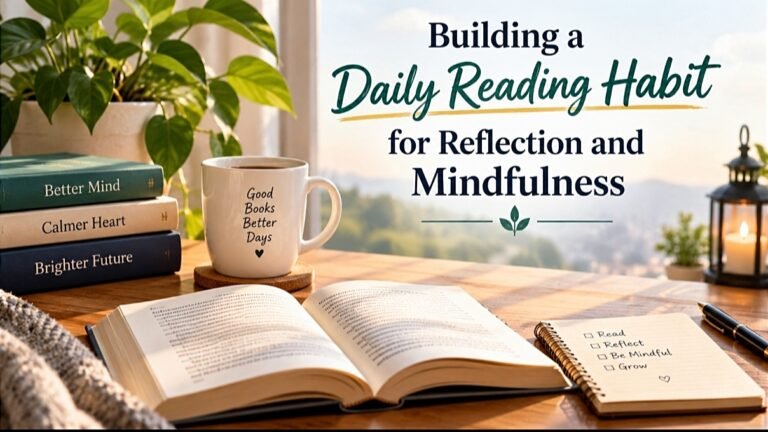
Tracking is not about turning reading into homework. A simple record is enough: what you read, for how long, and how it felt. That small act of noticing makes the habit visible, and visible habits are easier to keep. If you are still building the daily routine, start with our guide to Building a Daily Reading Habit for Reflection and Mindfulness, which shows how a short, calm session can fit into an ordinary day.
What to Track — and What Not to Obsess Over
A good reading log answers three questions: Did I read today? For how long? What did I read? Add detail only if it helps you keep going.
Pages read. Pages give a clear sense of movement through a long book. Do not worry if your daily count varies: twenty pages on a quiet Sunday and four on a busy Tuesday both count.
Minutes read. Time is often fairer than pages, especially if you switch between printed books, ebooks, and audiobooks. Ten focused minutes is a real session.
Books finished. Finishing a book is a satisfying milestone, and counting finished books over a year shows real progress. It is a slow measure, though, so do not use it as your only one.
Streaks. A streak — days in a row you have read — can motivate you, because nobody wants to break a chain. Treat it as encouragement, not a test: a missed day is a pause, not a failure.
Do not obsess over speed: reading faster is not reading better. Do not obsess over other people’s numbers either. And do not track so much that logging becomes a chore — if your system takes longer to fill in than the reading itself, it is too complicated.
Paper Tracking: Simple, Visible, and Phone-Free
Paper tracking is the oldest method, and for many readers it is still the best. A notebook, a bullet journal, or a printed habit tracker sheet gives you a record you can see without opening a screen. Ticking a box or colouring in a square after a session is a small reward, and that reward can make you want to do it again tomorrow.
Use a bullet journal page for the month, a habit tracker sheet with a row for reading and a square for each day, or a reading log notebook with the title, author, start and finish dates, a star rating, and a sentence about the book. Paper is cheap, never runs out of battery, and has no notifications. It cannot add up your totals or remind you to read, though, and it is easy to leave at home. It suits readers who enjoy writing by hand, who want a screen-free wind-down before bed, or who find apps distracting.
Try this simple weekly template. Draw five columns: Day, Book, Minutes, Pages, and One-line note. Fill in one row each evening. At the end of the week, add up the minutes and pages and write one sentence about the week — for example, “Read every evening, mostly before bed, and finished chapter six.” That two-minute review is where the habit really takes shape.
Free Apps: Goodreads, StoryGraph, and Bookly
Apps do the maths for you. They add up your totals, remember your dates, and show your progress in charts. Three free options cover most readers’ needs.
Goodreads is the largest book-tracking community. Shelve books as “want to read,” “currently reading,” or “read,” rate and review them, and set an annual reading challenge. Its core tracking is free, and its strength is its huge catalogue and social side.
StoryGraph is built around how you read, not just how much. It records the mood, pace, and length of what you read, and turns that into charts and personal statistics. Its core tracking and statistics are free, with a paid Plus plan for extra features.
Bookly is mainly a reading timer. Start a session, and it records your minutes and pages, keeps your streak, and shows your reading statistics. Some advanced features require a paid upgrade.
Paper or app? Paper wins for calm, screen-free reading. Apps win for automatic totals, reminders, and seeing your year at a glance. Many readers use both: an app for totals and a notebook for notes. If you need free books to start with, FreeBookSpot lists free books you can read and track.
How to Choose: Three Questions and a 7-Day Starter Plan
Ask three questions. First, do screens help you or distract you? If they distract you, choose paper. Second, do you want totals and charts, or just a daily tick? If you want totals, choose an app. Third, when do you read? If it is in bed at night, paper is calmer; if it is on a commute, an app is easier to carry.
Then try this 7-day starter plan: Day 1, pick one book and one method and read ten minutes. Day 2, read ten minutes and log it. Day 3, read at the same time as yesterday. Day 4, try fifteen minutes. Day 5, write one sentence about the book. Day 6, review your week. Day 7, add up your minutes and plan next week. Seven short days are worth more than one heroic afternoon.
Common Mistakes to Avoid
First, tracking too much: a log with ten columns will be abandoned within a week, so start with minutes and one note. Second, breaking a streak and quitting: one missed day does not erase the days before it, so read again tomorrow. Third, comparing yourself with others: reading is personal, and a habit that fits your life is the only one that lasts.
Conclusion
The best way to track your reading habit is the one you will actually use. Paper is calm and simple; apps are automatic and visual. Either way, the method matters far less than opening a book for ten minutes a day and noting it down. Start small, keep your log simple, and let the record show you that you are reading more than you think.
Frequently Asked Questions
What is the easiest way to track a reading habit for free? Log the date, the book, and the minutes you read each day, in a notebook or a free app such as Goodreads or StoryGraph.
Is paper or an app better for tracking reading? Paper is better for a screen-free routine; an app is better for automatic totals, charts, and reminders. Many readers use both.
How many minutes a day should I read? Ten minutes a day is a good starting goal — short enough to keep on a busy day, and long enough to build a habit.