Units and Measurements: A Simple Beginner’s Guide (2026)
Units and measurements are the quiet backbone of everyday life. Every time you check the weather or follow a recipe, you are using units and measurements — usually without even thinking about it. This guide explains what units and measurements are, how the metric and imperial systems differ, and gives you the conversions you will actually use.
What Are Units and Measurements?
A measurement is a number plus a unit. The number tells you how much; the unit tells you how much of what. Saying a table is “6” means nothing. Saying it is “6 feet long” tells you everything. Without agreed units, trade, science, cooking, and construction would fall apart.
That is why standard systems exist. A unit is only useful when everyone agrees on it. Today, the whole world agrees on one system: the metric system, formally called the International System of Units (SI). It was developed in France in the 1790s, during the French Revolution, and it spread because it is simple — everything is based on tens. One metre is 100 centimetres. One kilogram is 1,000 grams. One litre is 1,000 millilitres.
The 7 SI Base Units
Every measurement in science starts from just seven base units. Everything else — speed, area, volume, pressure — is built by combining them:
- Metre (m) — length.
- Kilogram (kg) — mass.
- Second (s) — time.
- Ampere (A) — electric current, the flow of electricity through a wire.
- Kelvin (K) — temperature, starting at absolute zero; everyday life uses Celsius, which is kelvin minus 273.15.
- Mole (mol) — amount of substance.
- Candela (cd) — luminous intensity, how bright a light source is in a given direction.
In 2019, the SI system was redefined so that these units are based on unchanging constants of nature — for example, the kilogram is now defined using the Planck constant — instead of physical objects kept in a vault.
Metric vs Imperial: Why the World Uses Two Systems
If the metric system is so simple, why do some countries still use feet, pounds, and gallons? The answer is history. The imperial system grew out of old British units — the foot was once literally based on a human foot, and the yard on the distance from a king’s nose to his fingertip. Britain moved to metric for most official purposes decades ago, but road signs still show miles, and people still give their weight in stones and pounds.
Today, only three countries still officially use imperial units as their main system: the United States, Liberia, and Myanmar. Everyone else uses metric. That split is why conversions matter — a recipe from an American website gives cups and Fahrenheit, while a recipe from Europe gives grams and Celsius.
Everyday Conversions You Will Actually Use
You do not need to memorise a whole units and measurements conversion table. These are the ones that come up again and again.
Length. One inch is exactly 2.54 centimetres. One foot is 30.48 centimetres. One yard is 0.9144 metres. One mile is about 1.61 kilometres. To turn miles into kilometres, multiply by 1.6.
Weight. One kilogram is 2.2 pounds. One pound is about 454 grams. One ounce is about 28 grams.
Volume. One litre is about 0.26 US gallons, and one US gallon is about 3.79 litres. One US cup is about 237 millilitres.
Temperature. To turn Fahrenheit into Celsius, subtract 32 and multiply by 5/9. To go the other way, multiply Celsius by 9/5 and add 32. Water freezes at 0°C (32°F) and boils at 100°C (212°F). Normal body temperature is about 37°C, or 98.6°F.
Area. One hectare is 10,000 square metres — about the size of a sports field. One acre is about 4,047 square metres, or roughly 0.4 hectares.
The apps behind your phone’s units and measurements converter are built by people working in information technology — a field where precise measurement is part of daily work.
Common Measurement Mistakes to Avoid
Mixing up weight and volume. A cup measures volume, not weight. A cup of flour and a cup of honey do not weigh the same, because honey is denser.
Confusing US and UK units. A US gallon and a UK gallon are not the same — the UK gallon is about 20% larger. A US pint is 473 millilitres; a UK pint is 568 millilitres.
Forgetting that temperature scales start in different places. Zero on the Celsius scale is the freezing point of water, but zero Fahrenheit is much colder — about minus 18°C. That is why a “cold” 30°F day in the US is actually below freezing, while 30°C is a hot summer day.
Measuring from the wrong end. Many DIY mistakes come from starting a tape measure at the 1-inch mark instead of zero, or reading centimetres as inches. Always check the zero point before you cut.
Rounding too early. If you convert 10 miles to 16 kilometres and then convert back, you get 9.94 miles, not 10. Keep one extra decimal while you work, and round only at the end.
A Quick Checklist for Measuring Anything
Use this checklist whenever accuracy matters — cooking, DIY, travel, or work.
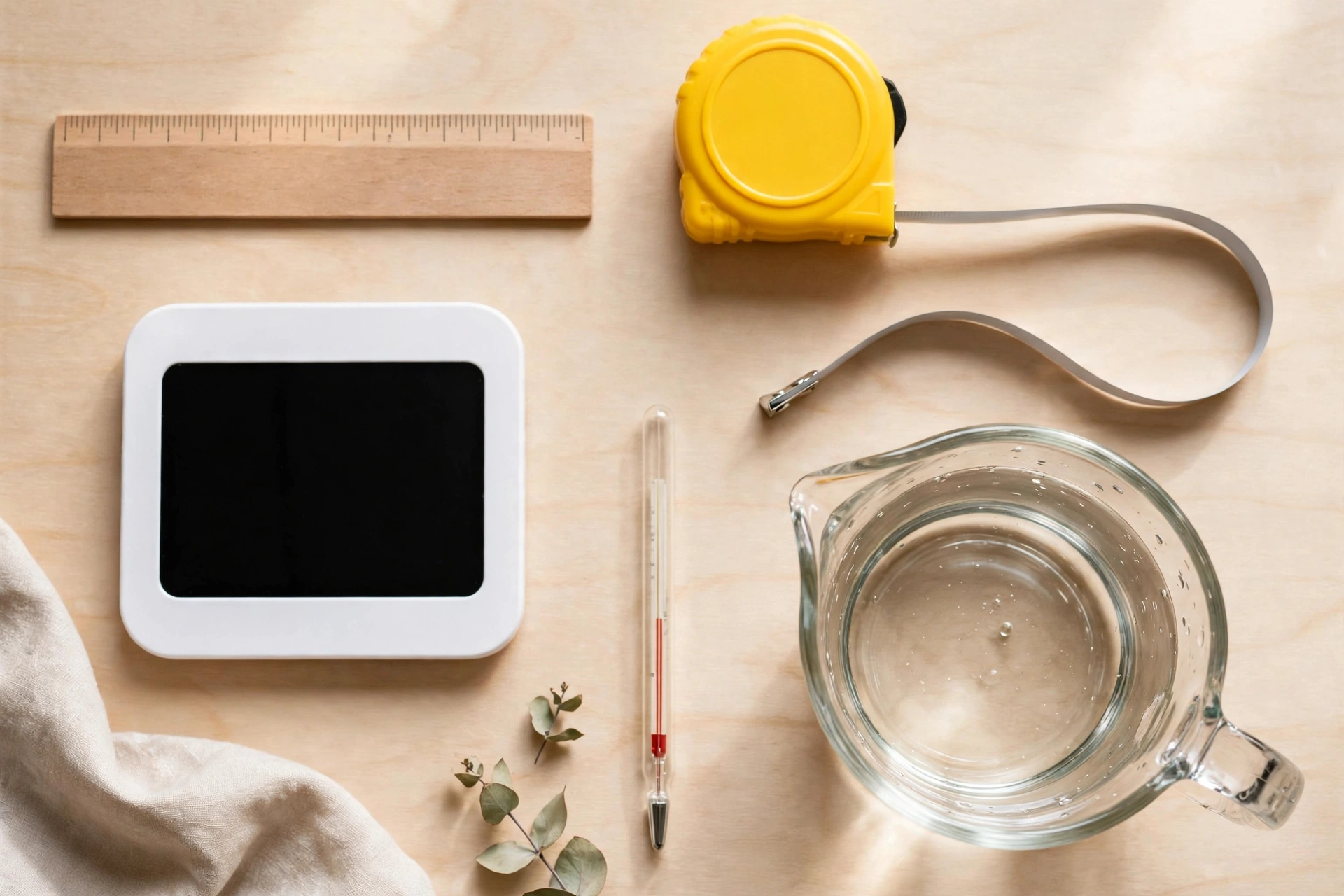
- Pick the right tool. Ruler for short lengths, tape measure for rooms, kitchen scale for ingredients, thermometer for temperature.
- Check the units first. Confirm whether you need centimetres or inches, grams or ounces, Celsius or Fahrenheit.
- Measure twice, cut once. The carpenter’s rule saves time, money, and material.
- Write it down immediately. Note the number and the unit together.
- Convert once, at the end. Do all your measuring in one system, then convert the final answer if you need to.
- Sanity-check the result. If your answer says a room is 3 centimetres wide, you read the wrong scale.
Businesses live by the same idea: what gets measured gets managed. If a business wants more visitors, it first has to measure how many it has, which is why a small business SEO checklist starts with tracking real numbers.
Frequently Asked Questions
What is the difference between a unit and a measurement?
A unit is the standard amount, like a metre or a kilogram. A measurement is the result of comparing something to that unit — a number plus the unit, like “2 metres” or “5 kilograms”.
Why does the US still use the imperial system?
The US adopted the metric system for official use in 1975, but the change was voluntary and never enforced in daily life. Roads, recipes, construction, and sports all stayed imperial, so the old units survived through habit and the cost of changing every sign, tool, and textbook.
How do I convert units quickly without a calculator?
Learn a few rough rules: multiply miles by 1.6 for kilometres, double kilograms for pounds, and remember that 1 litre is about 4 cups.
Final Thoughts
Units and measurements are not just a school subject. They are a life skill. The next time you read a recipe or check a weather forecast in another country, you will know exactly what the numbers mean — and you will be able to switch between systems without guessing. Start with the seven SI base units, keep the everyday units and measurements conversions above close at hand, and measure twice before you cut. See our roundup of 2026 reading trends, which shows how reading habits themselves are changing.